
Highlights
- •Normal aging reduces slow-wave and REM sleep without necessarily indicating pathology.
- •Sleep disorders affect 20–40% of older adults with insomnia and > 30% with obstructive sleep apnea.
- •Chronic sleep disturbances increase dementia risk by 19–50% in longitudinal studies.
- •Cognitive-behavioral therapy demonstrates superiority over pharmacotherapy for late-life insomnia.
- •Dual orexin receptor antagonists offer promising hypnotic alternatives with reduced fall risk.
Abstract
Population aging accelerates globally, increasing sleep-related complaints among older adults. These disorders substantially impact cognitive function, physical health, and quality of life. This narrative review examines age-related changes in sleep architecture, alterations in circadian rhythm, common sleep disorders, and modifiable behavioral factors in older populations. We searched PubMed, Web of Science, and Google Scholar through December 2025 for studies involving adults aged ≥ 65 years focusing on sleep patterns, architecture, circadian rhythms, and disorders. Normal aging involves reduced slow-wave and REM sleep, decreased sleep efficiency, increased fragmentation, and circadian amplitude dampening. However, pathological sleep disorders affect substantial proportions: insomnia (20–40%), obstructive sleep apnea (>30%), restless legs syndrome, and REM sleep behavior disorder. Chronic sleep disturbances are associated with elevated risks of cognitive decline, cardiovascular disease, falls, frailty, and mortality. Evidence supports cognitive-behavioral therapy as a first-line insomnia treatment. Emerging dual orexin receptor antagonists show promise with favorable safety profiles. Continuous positive airway pressure remains the standard of care for obstructive sleep apnea, though adherence challenges persist. Sleep may represent a modifiable healthy aging determinant. Distinguishing normal age-related changes from pathological disorders can enable appropriate management. Future priorities include longitudinal studies in the oldest-old, investigations of circadian mechanisms, implementation of behavioral interventions, and equity-focused research across diverse populations.
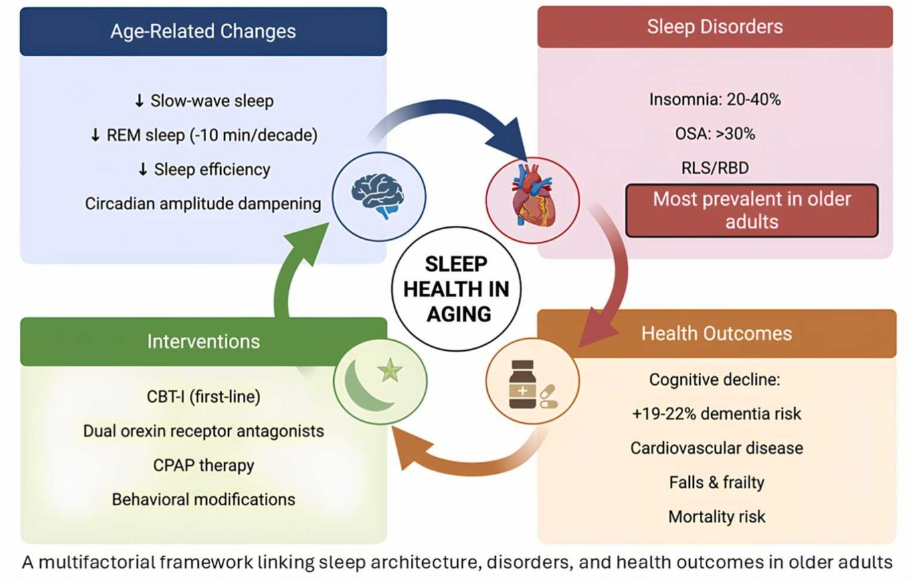
Multifactorial framework of sleep health in older adults, showing bidirectional relationships between age-related changes, sleep disorders, interventions, and health outcomes.
Introduction
The global population is increasingly aging; by 2050, people aged 60 and above will double to 2.1 billion and constitute around 20% of the global population (WHO, 2025). Sleep complaints are common in geriatric populations and frequently co-occur with multiple medical and psychiatric disorders (Bahammam and Pandi-Perumal, 2010). Polypharmacy, retirement-related lifestyle changes, social isolation, increasing frailty, and residence in long-term facilities such as dementia care, nursing homes, and older adults’ home care units further contribute to sleep disruption (Martin and Ancoli-Israel, 2008, Yu et al., 2018). Looking at the pros and cons of living a longer life. The older adult population has accumulated experience, the core of wisdom, and the best decision-making skills to handle high-demand jobs. However, these populations are more susceptible to multiple comorbidities and greater health demands.
The human circadian pacemaker is the suprachiasmatic nucleus (SCN), which primarily functions through light activation, while healthy adults typically experience sleep periods averaging 7–8 h in darkness (Larson-Prior et al., 2017). With the normal advancing age process, changes in the internal clock and circadian rhythms lead to earlier shifting of sleep cycles (Espiritu, 2008). However, findings regarding total sleep time (TST) remain inconsistent. Several studies report no significant change in 24-hour sleep time, which remains around 7 h (Ancoli-Israel, 2009, Ohayon and Vecchierini, 2005), whereas others describe a reduction in TST (Espiritu, 2008). In our view, the perception that TST decreases may, in part, reflect the omission of daytime napping when estimating 24-hour sleep, leading some reports to underestimate actual total sleep duration. These changes do not lead to the development of sleep disorders, as healthy aging can be supported by healthy sleep habits, behaviors, and environments.
A recent systematic review concludes by discussing 65 global conceptions and definitions of healthy ageing, demonstrating that numerous conceptualizations accentuate its multidimensionality and complexity, making a monistic model or description impractical. Lifelong interactions between individuals and their settings, along with adaptations, environmental factors, and health promotion or empowerment, are crucial for advancing health (Menassa et al., 2023). Their classification approach establishes a framework for standardized terminology and metrics that might facilitate research, enable comparisons of empirical results, and influence social and health policies to promote health equity across diverse populations and circumstances.
When it comes to the prevalence of sleep disorders with advanced age, a wide range of data worldwide has been reported in the literature. 36% of older adults without any comorbid conditions (aged 65 or above) have sleep disturbances, reaching 69% if accompanied by four or more comorbid conditions. (Didikoglu et al., 2020). While the sex gap in OSA prevalence narrows in older populations, likely reflecting the post-menopausal rise in female OSA risk, substantial sex differences persist for other sleep disorders. Insomnia remains more prevalent in women across all age groups (Jaussent et al., 2011, Wolkove et al., 2007). RLS prevalence is approximately twice as high in women (Perger et al., 2024), and REM sleep behavior disorder is considerably more common in men (Perger et al., 2024). A systematic review on the worldwide prevalence of sleep disorders includes 252 studies and nearly 1 million participants (36 countries, 1988–2023). Results indicated that the most common sleep disorder is obstructive sleep apnea (OSA; 46%), followed by insomnia (29%) and excessive daytime sleepiness (19%) (Canever et al., 2024). Canever, Zurman et al. (Canever et al., 2024) reported that gender differences in the overall pooled prevalence of sleep disorders were not statistically significant in older populations. However, this finding may reflect the heterogeneity of disorders included in the analysis rather than a true absence of sex-specific patterns (Canever et al., 2024). Healthy aging is a cornerstone of longevity. With advancing age, micro- and macro-sleep structural changes increase alongside a loss of circadian amplitude, leading to lighter, fragmented sleep and an advancing sleep pattern (Bahammam and Pandi-Perumal, 2010, Bragazzi et al., 2025, Espiritu, 2008).
“Successful aging” is a term first introduced in 1961 (Havighurst, 1961), then defined by K&R as three central pillars: minimizing disorders and disability, preserving a high level of physical activity and cognitive function, and sustained engagement in life activities, while maintaining optimal cognitive and functional capacities (Rowe and Kahn, 1997). However, this model has limitations because it forces older individuals to manage aspects of their lives that are beyond their control, such as being diagnosed with disorders that lack a known underlying etiology, attributing these issues to pathological disabilities, and narrowing the ideal of productivity and independence. For these reasons, ageing should not be conceptualized as an easy or achievable competition, but rather as adaptability and the personal capability to respond actively to biological and psychological processes shaped by stochastic factors, life courses, and a wide variety of environmental, social, ethical, and moral factors. In contrast, the World Health Organization (WHO) shifts the focus from “successful” to “healthy” or “active”, emphasizing the process of developing and maintaining functional abilities that enable well-being in older adults. Moreover, functional ability refers to the capabilities that allow individuals to do what they value, including learning, personal growth, decision-making, mobility, building and sustaining relationships, and contributing to social activities and society (Rudnicka et al., 2020). Based on the WHO, these functional abilities result from the dynamic interaction between internal (biological, physiological, and mental ageing processes) and external environmental factors (home, community, and society) (Rudnicka et al., 2020). In a prospective UK Biobank cohort of 60,977 adults (mean age 62.8 years, 55% female), Windred, Burns et al. (2024) demonstrated that participants with the highest sleep regularity index scores had a 30% lower risk of all-cause mortality compared with the least regular quintile after full adjustment for demographic, lifestyle, and health confounders (HR 0.70, 95% CI 0.59–0.83). Sleep regularity was a stronger predictor of mortality than sleep duration in that analysis, and the addition of sleep duration to regularity-based models did not explain significant additional variance in mortality risk (Guo et al., 2024).
Sleep is increasingly regarded as the “third pillar” of health alongside nutrition and physical activity. Adequate sleep is essential for cognitive function, mental health, immune competence, and cardiometabolic health, all of which influence how well individuals age (Ancoli-Israel, 2009). Conversely, chronic poor sleep or sleep disorders in late life are linked to a host of adverse outcomes, from impaired memory and mood to a higher risk of cardiovascular disease, dementia, and even mortality (Ancoli-Israel, 2009).
The purpose of this study is to comprehensively review perspectives on age-related changes in sleep architecture and overall sleep quality, the physiological mechanisms that influence circadian rhythm modulation throughout the ageing process, common sleep disorders that are prevalent among older adults, and to discuss the impact of lifestyle and modifiable behavioral factors on sleep health within this demographic group.
https://www.sciencedirect.com/science/article/abs/pii/S1568163726000930#article
